
🐟 Fish Wheel Generator
Spin, discover and explore amazing fish!
🐠 Fish Collections
✏️ Customize the Wheel
⚙️ Wheel Settings
🏆 Spin History
- No winners yet.
Choosing between sharks, reef fish, and other sea creatures becomes effortless with a Fish Wheel Generator. This interactive random picker transforms ordinary classroom prompts into engaging experiences while supporting learning, storytelling, and independent research.
Rather than selecting familiar animals repeatedly, players can explore unexpected choices through a simple spin button. Teachers can customize the wheel, encourage trivia, introduce unfamiliar habitats, and make ocean discovery enjoyable through collaborative games.
Table of Contents
How to Use Fish Wheel Generator ?
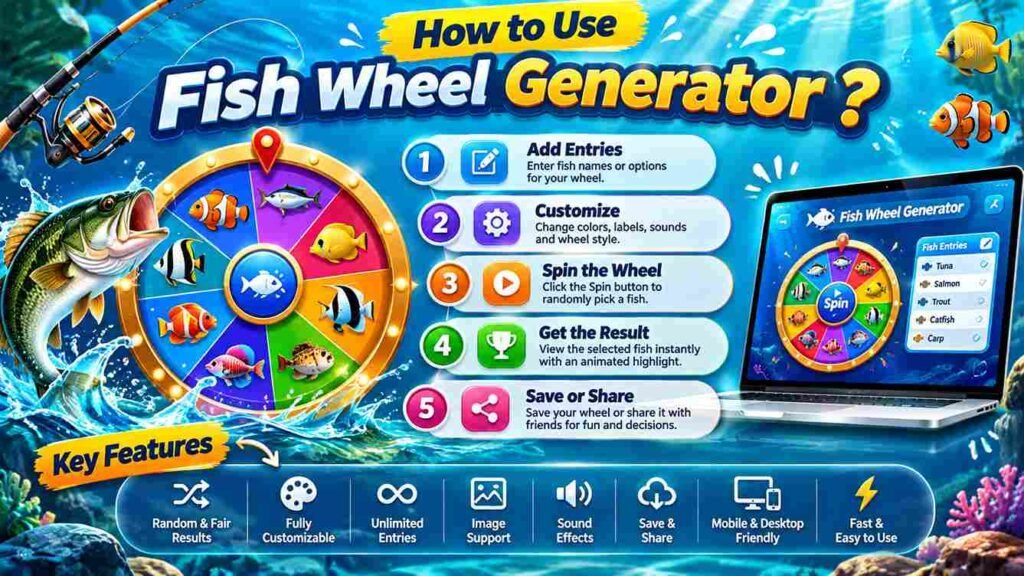
Start by reviewing the pre-filled list or add your preferred aquatic animals. Press the spin button in the center, allowing the spinner to rotate until the pointer selects a random fish within a few seconds.
For controlled activities, open wheel settings to adjust the spinning speed, enable elimination mode, or assign weights to specific items. These options help maintain variety during repeated turns while supporting different educational and recreational purposes.
Uses / Activities (Classroom, Family, Games)
During science lessons, teachers can turn a random segment into a research subject, encouraging kids to explore marine mammals. Assigning a drawing prompt also makes practicing vocabulary more engaging while strengthening observation skills through participation.
For family activities, combine charades, storytelling, and trivia to keep everyone involved. Each participant can spin the wheel, identify the picked animal, and create imaginative challenges, making group activities enjoyable for both children and adults.
What’s on the Wheel (Animals / Fish Included)
The fish wheel brings together jellyfish, dolphins, rays, and octopuses alongside crustaceans and reef organisms. Its varied categories encourage users to discover marine diversity while exploring familiar and unusual species through an interactive spinning experience.
Participants can encounter turtles, whales, seabirds, hammerhead shark, blue whale, and manta ray entries. Including deep-sea creatures, coral reef animals, and endangered species creates opportunities for learning, drawing, and comparing animal groups during educational activities.
Also Read: Bird Wheel Generator – Spin & Pick a Random Bird!
Customize the Wheel
A smaller selection often creates better games than crowded segments. Remove unsuitable fish, rename unfamiliar species, or add a favorite aquatic animal. Configure the appearance, sound, and weighted choice according to your specific activity requirements.
For classrooms, duplicate the customized wheel before adjusting its settings for different lessons. Edit individual wheel items, enable auto-save, and share the URL with friends. Use elimination mode to avoid repeats during a game session.
Spontaneity vs. Deliberation
A random fish generator reduces hesitation when quick choices matter, but chance cannot replace thoughtful deliberation. During classroom activities, selecting a sea creature spontaneously encourages curiosity while evaluating its habitat supports meaningful learning through research.
Finding balance between spontaneity and structured decision strategies creates harmony. A spinner wheel complements careful planning, allowing participants to overcome indecision, explore unfamiliar options, and decide when independent judgment matters more than purely random selection.
Indecision
Too much deliberation can turn a simple choice into unnecessary frustration. A fish wheel serves as a decision-making tool, letting chance select an aquatic animal when equally appealing alternatives make choosing difficult during classroom activities.
Rather than becoming a dictator, the random picker acts as a guide, combining spontaneity with your own judgment. For example, selecting a seafood dish becomes easier when the available options already suit your personal preferences.
Also Read: Random Letter Wheel – Spin & Pick a Letter
Finding Harmony in Choice
Finding balance does not require a perfect decision. A fish wheel offers fair results while encouraging curiosity about different animal options. Establishing clear rules beforehand helps everyone enjoy the selection process without unnecessary personal disagreements.
During lessons, combining randomness with familiar local species creates meaningful participation. Allowing each student to explore the picked creature encourages independent thinking, while using favorites occasionally maintains enthusiasm without sacrificing fairness or limiting learning opportunities.
Share It With Your Group
Rather than selecting fish individually, generate a link to your custom version and send it to your family, friends, or class. Everyone can explore aquatic creature choices through shared activities while maintaining identical selection options.
Teachers can publish their wheel for assigning research, while friends use share links for party games. Keep participants involved by encouraging each team to share a fact, compare results, and discover unfamiliar fish species together.
Why Use GoSpinWheel?
GoSpinWheel makes selecting aquatic creatures simple through custom spin wheels, weighted choices, and customizable slices. Teachers can use selected animals for starting discussions, while families enjoy family-friendly activities without spending time debating their next choice.
The wheel maker supports creative prompts, trivia topic selection, and Zoom games. Its online format brings participants together, making group chats more interactive while helping users explore animal groups through spontaneous selections and educational challenges.
Simultaneous Multi-Wheel
Running multiple wheels together makes Zoom games and classroom warm-ups more interactive. Assign one wheel to animal groups and another to prompts, allowing participants to identify selected creatures while completing different challenges within each round.
A shared activity becomes more engaging when separate wheels determine a trivia topic, story character, or charades clue. Using the same setup, teachers can organize group challenges without interrupting the natural pace of each activity.
True Randomness (RNG)
A spinning animation does not guarantee unbiased selection. The generator relies on computer-generated numbers and pseudo-random techniques that are random enough for nearly all uses, including classroom activities, fishing challenges, and recreational aquatic discovery games.
When testing decision-making algorithms, check whether timing settings influence outcomes. Equally weighted entries should have identical winning chances in practice, while customized probabilities intentionally make certain fish more likely to win without being rigged.
Weighted Choice
Equal probability is not always useful when designing aquatic challenges. You can duplicate entries or weight results so selected species show up more often, while maintaining unpredictable outcomes across different rounds of a classroom activity.
For example, assign greater probability to shark and dolphin entries while keeping harder answers less frequent. These adjusted probabilities help teachers match activities with student knowledge and gradually introduce unfamiliar species during interactive learning sessions.
OBS Streamer Mode
Keep your broadcast visually clean by displaying the fish spinner through OBS Browser Source. Match the wheel theme with your stream layout, adjust spinning time, and manage sounds without interrupting audience interaction during live sessions.
For interactive giveaways, position the spinner beside your gameplay window and announce each winner. Disable distracting confetti or adjust the winning sound to maintain professional audio balance while keeping viewers engaged throughout every selection round.
Elimination Mode
Elimination mode helps remove selected fish automatically, preventing repeats during successive rounds. As available slices decrease, each remaining species receives an equal selection opportunity when weights are identical, making classroom competitions engaging and fair.
Teachers can organize charades, assign reports, or introduce vocabulary challenges without repeating species. Keeping completed results visible helps participants track previous selections, while allowing organizers to restore the original wheel for another activity later.
Also Read: Nature and animalsShare Links
Sharing a fish wheel through group chats helps participants access custom spin wheels without rebuilding their selections. Simply use the copy icon to distribute configurations, allowing friends and classmates to explore identical challenges together.
For teachers, sharing an ocean animal generator makes starting discussions easier during science lessons. Participants can access edited selections online, explore unfamiliar species, and enjoy family-friendly activities without manually entering every animal name before playing.
Auto-Save & Sync
Accidental refreshes should never interrupt an ocean animal wheel session. Auto-save preserves your customized entries automatically, allowing you to rename or reorder fish without losing previous adjustments during classroom activities or an exciting aquarium trip.
Synchronization helps maintain consistent settings across supported devices, while JSON files offer another way to back up configurations. Teachers can export personalized wheels, import previous collections, and resume activities without rebuilding their entire selection manually.
Import / Export
Instead of rebuilding selections through fast editing, import existing fish lists containing 60 marine animals or personalized entries. This approach lets teachers create your own activities while preserving consistent configurations across multiple sessions and devices.
Exporting saved configurations provides reliable backups beyond Local Storage. Whether preparing research resources or managing up to six wheels, transferring compatible files simplifies organization without depending on the same device to recover previous custom settings.
Conclusion
A free fish wheel turns ordinary marine exploration into interactive learning. Whether discovering rays, dolphins, or jellyfish, participants can play together, explore different topics, and uncover a surprising fact about life beneath the oceans.
Rather than relying on basic wheel spinners, choose an experience that suits your child’s age. Encourage participants to sketch, describe, or imitate selected creatures, making every spin useful for creative activities, entertainment, and educational discovery.
Is the Spinner Wheel Truly Random?
Yes, a properly implemented RNG uses the browser’s built-in crypto.getRandomValues() function to generate unpredictable selections. A fully randomized outcome makes attempts to cheat difficult, while unbiased pre-processing helps maintain fairness whenever users click to spin.
Is It Possible to Cheat?
Even a truly random spinner can become unfair when participants secretly modify entries or weights. Before streaming, inspect the wheel maker settings, check whether options were removed, and ensure everyone understands the selection rules beforehand.
Can I Customize the List of Sea Creatures?
Yes, customize your wheel by adding whales, octopus, turtles, or smaller ocean organisms. For themed activities, organize crustaceans and cephalopods into separate lists, making each spin relevant to classroom discussions, games, or marine exploration projects.
Can I Edit the Aquatic Animals Wheel Items?
Yes. Edit aquatic animal entries to suit your activity, whether you’re organizing drawings by an animal’s group or planning a beach quiz. Check each name before spinning, and save your customized list for later use.
What Is the Ocean Animal Generator Wheel?
An ocean animal generator wheel randomly selects marine creatures through a spinning interface. Unlike a name picker, it encourages underwater exploration, species comparisons, and educational Pictionary activities while making animal discovery engaging for every age.